LinkedIn Single Image Ads vs Video Ads for B2B
Pick the format that matches where your prospect sits in the buying journey.

- Written by
- Dae-Jung Kwon
- Published
- October 14, 2026
- Reading time
- 9 min read
What this covers
When you sit down to plan a LinkedIn campaign, you probably ask the wrong question. They ask which format performs better, single image or video, as if one should win and the other should lose. The question that actually matters is simpler and harder: what does this account need to believe or understand right now, at this exact point in its buying journey? A B2B deal today moves through a group, not a person. With that many people involved, at that many different stages of conviction, a format that works beautifully at one point will fall flat at another. It's a matter of fit, and fit depends entirely on where the account sits in the funnel.
Single Image Ads and Budget Share
Single image ads hold the largest share of LinkedIn ad budgets for a plain reason: they are the cheapest, fastest way to get a brand in front of the right companies before any real conversation has started. Without account-level targeting, those impressions spread across audiences that may never buy anything, so precision in who sees the ad matters as much as the ad itself.
The format earns its place for a few concrete reasons. A team without a dedicated creative department can produce and launch a single image ad in hours, not weeks. Testing messages is simple: change one variable, hold everything else steady, and read the result. And because the whole message sits in one frame, there's no dependence on a viewer sticking around for a payoff at the end, the way there is with video.
The numbers set realistic expectations. The more useful finding sits with the top performers, the ads clearing 2% CTR. Stock imagery is a quiet tax on performance.
There's a billing trap, too: every click on "Read more," the link that expands a truncated intro line, counts as a paid click, whether or not the person had any real interest in the offer. Keeping intro text under 150 characters avoids paying for idle curiosity.
Specs shape delivery as much as they shape appearance. Horizontal images at 1200×628px (a 1.91:1 ratio) and square images at 1200×1200px both run on desktop and mobile. Vertical formats, 720×900px recommended, 628×1200px supported but bordered, run on mobile only, a real constraint for any B2B audience that's heavily desktop-based. File size tops out at 5 MB, formats are JPG, PNG, or GIF (animated, capped at 250 frames). Headlines can run to 200 characters but perform best around 70. Intro text can run to 600 characters but should stay near 150.
Video Ads and Lower CTR
Judging video ads by CTR misreads what the format is built to do. Video works on attention and comprehension, not clicks. Someone who watches a 60-second explainer all the way through has absorbed something a static image simply cannot deliver in one glance. Clarity of the message matters far more than how polished the production looks.
Video draws engagement that CTR doesn't capture. Video ads draw more comments per impression than static ads, a sign that the format sparks the kind of back-and-forth that shapes opinion inside a buying group. View-through data, the share of viewers who stuck around for 25%, 50%, 75%, or the full video, tells an advertiser something CTR can never show: how much of the actual message got through.
That view-through data has a second life beyond measurement. Anyone who watches past 75% has shown real intent, far more than a cold impression ever could, and that audience can be pulled into a retargeting list and served different creative in the next step of the campaign. The format has a real cost, too: scripting, filming, and editing take time and money that a team without creative resources may not have on hand, and that's a legitimate reason some organizations run video less often or at a smaller scale. The bar for production value is lower than most teams assume.
Cost and Efficiency by Funnel Stage
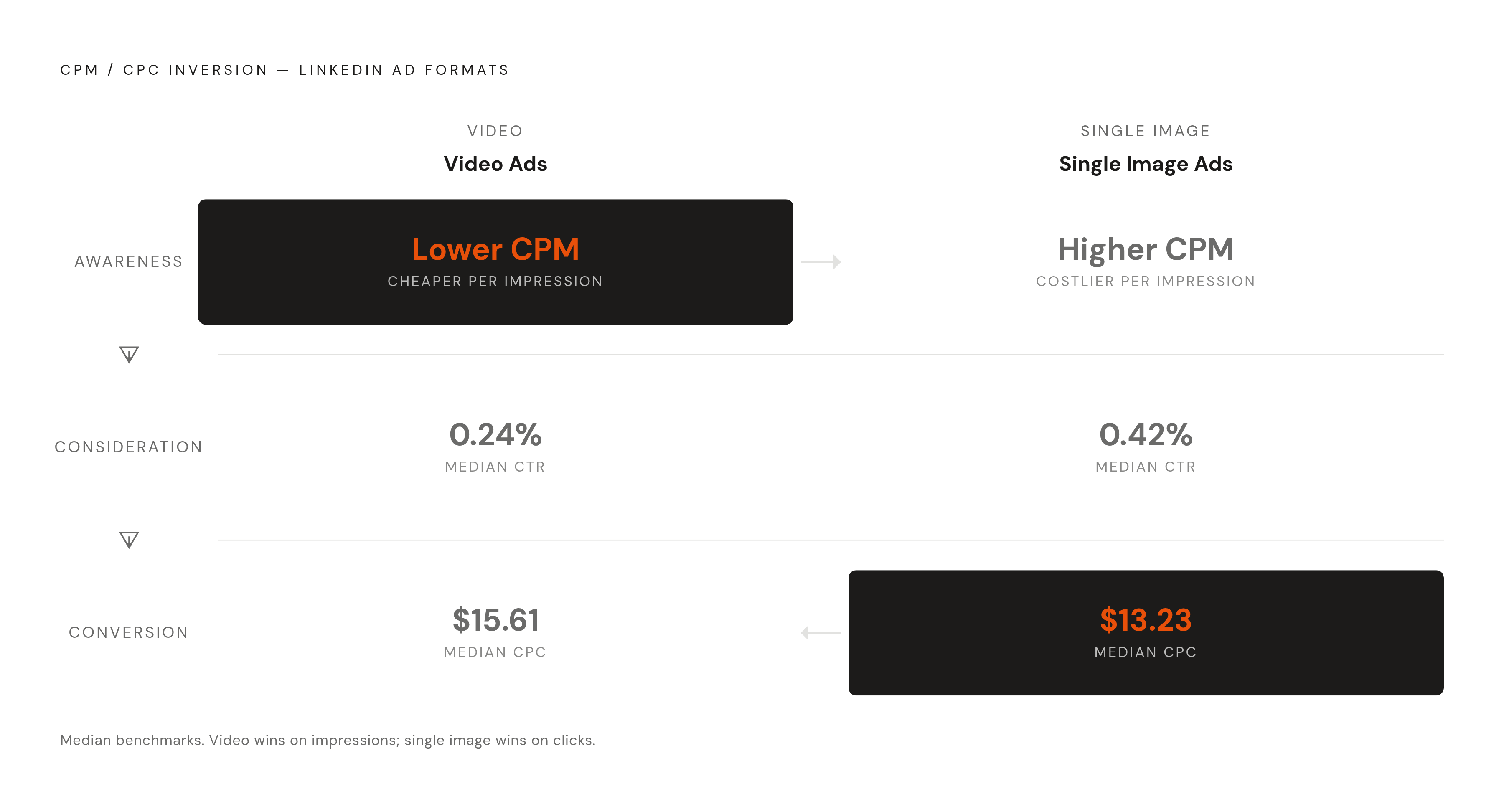
Comparing cost between single image and video depends on what the campaign is actually buying: clicks or impressions. The 2026 ZenABM benchmarks lay the numbers out side by side. Single image runs a median CTR of 0.42%, a median CPC of $13.23, and a higher CPM. Video runs a median CTR of 0.24%, a median CPC of $15.61, and a lower CPM. Single image buys more clicks per dollar. Video buys more impressions per dollar.
That translates directly into funnel strategy. At the awareness stage, when the goal is reaching as many qualified accounts as possible, video's lower CPM stretches the budget further, putting the brand in front of more members of the buying group for the same spend. At consideration and conversion, when the goal is a specific action, filling out a form, requesting a demo, single image's lower CPC and higher CTR earn more of those actions for the same money. Neither format is more efficient in the abstract. Each is more efficient at the job it's suited for.
Using Both Formats Together in a Sequential Funnel
The strongest B2B LinkedIn campaigns don't pick a side between single image and video. They run both in sequence: video builds an audience, and single image converts it.
The structure looks like this. At the top of the funnel, a video ad runs at a lower CPM against a broad account list, aiming for impressions and view-through data. In the middle of the funnel, anyone who watched past 50% gets retargeted with a second video or a document ad that digs deeper into the specific problem being solved. Those viewers have already self-selected by sticking with the first video, so they're ready for more substance. At the bottom of the funnel, anyone who watched past 75%, or engaged with that mid-funnel content, gets served a single image ad carrying a specific call to action: a demo request, a trial sign-up, a case study download. Single image's click efficiency pays off there.
Single image and video are two instruments inside that coordinated motion, not competing alternatives.
Two other formats slot naturally into this sequence. Carousel ads work well at the mid-funnel layer, where a buying committee includes different roles that need different messages, so a CFO card can focus on cost and a practitioner card on workflow, inside the same campaign. Document ads tend to enter at the evaluation stage, when senior decision-makers do serious, hands-on research. The format signals depth, but it lives or dies on the content inside it. A weak document won't earn saves no matter how well it's targeted.
AI-Powered Tools for Campaign Creation and Creative Production
AI tools are closing the production gap that used to push most teams toward single image by default, simply because video took too much time and money to produce. That changes the calculation for anyone who skipped video for resource reasons alone.
It cuts setup time down to 30 to 45 minutes, compared with 2 to 4 hours for building a Classic campaign by hand, with a benchmark cost-per-acquisition up to 42% lower.
Adside combines AI-generated creative briefs, copy variants, audience targeting, and auto-resized creatives across LinkedIn, Google, Meta, Reddit, and Twitter, all inside one interface, removing the need to stitch together separate creative tools, analytics dashboards, and bulk-import apps. It's built for startups that want to run their own campaigns without an agency retainer, whether that means working self-serve or handing the work to a managed service. Elsewhere in the category, Predis.ai takes product information and simple prompts and generates image and video ad variations straight from them, so you can get fast creative output without building a brief from scratch.
The direction all of this is heading looks increasingly agentic. Newer tools generate LinkedIn ad copy and visuals by studying top-performing ads for inspiration, assemble full campaigns and audiences on their own, publish automatically or wait for approval, and reallocate budget around the clock, pausing weak performers without anyone stepping in. The advertiser's job shifts from doing the work to reviewing it.
How competitor ad tracking informs which format and message to run before spending budget
Knowing what competitors are running on LinkedIn, and what creative choices they're making, cuts out a lot of the guesswork before a single dollar goes toward a campaign.
A few free, platform-native tools cover the basics. Meta's Ad Library covers Facebook, Instagram, Messenger, Audience Network, Threads, and WhatsApp. It shows no spend data for most commercial advertisers, but it now displays 12-month cumulative spend for roughly 38,000 advertisers along with impression-range buckets for every ad. Google's Ads Transparency Center covers search, display, YouTube, Shopping, Maps, Gmail, and Play, spanning text, image, and video formats.
What this research actually changes is the format decision itself. If every major player in a category is running single image ads built around product screenshots at the top of the funnel, and nobody is running video, that's either an open opportunity to differentiate with video or a sign the category hasn't yet educated its buyers on the problem worth solving. Either way, you want that information before a campaign launches, not after. Adside folds competitor ad tracking and market research directly into the same platform used to build and run campaigns, so the intelligence that shapes a format decision sits next to the tools that act on it, instead of living in a separate spreadsheet somewhere.
Running LinkedIn video and single image ads across a multi-channel stack without losing attribution
The LinkedIn funnel rarely closes on LinkedIn. Most B2B buyers see an ad there, go research the company on Google, and eventually convert through search or by typing the URL in directly. Measuring LinkedIn in isolation will undercount what its video and single image ads are actually contributing to the pipeline.
Watching LinkedIn alongside Google and Meta in one unified view closes the attribution gaps that show up constantly in single-channel agency setups. A LinkedIn video builds the awareness that later makes a branded search convert, but that connection disappears entirely when you measure each channel on its own. Reddit has also become a standard channel for B2B agencies working alongside the three major platforms, with teams mapping relevant subreddits, tracking buyer conversations and competitor mentions, and building subreddit-specific messaging around real buying intent.
Adside runs across Google, Meta, LinkedIn, Reddit, and Twitter from a single interface, covering campaign creation, performance monitoring, and reporting, which makes it possible to trace how LinkedIn video impressions connect to conversions happening on other channels, without stitching together five separate dashboards by hand.
A practical decision framework: which format to run, at which stage, given your team's resources
The format decision comes down to three inputs: where the target account sits in its buying journey, whether the campaign's real goal is impressions or clicks, and what the team can realistically produce given the creative resources on hand.
By funnel stage, the logic holds steady. At the top of the funnel, for awareness, video earns its place through CPM efficiency and by building the retargeting audience for later stages; single image with a tightly built account list works as the substitute when video production isn't realistic yet. In the middle of the funnel, video drives category education across multiple stakeholders, document ads reach senior decision-makers who do serious research, and carousel ads speak to different roles inside the same target account. At the bottom of the funnel, for conversion, single image with a specific call to action does the job, where its higher CTR and lower CPC serve the goal directly.
Resources shape the starting point as much as funnel stage does. A small team or an early-stage startup without dedicated creative support should start with single image, lean on AI tools, including Adside's AI-generated briefs, copy variants, and auto-resized creatives, to iterate fast, and bring video in once a 15 to 30 second "real talk" format becomes workable, since production polish was never the real barrier. A growth-stage brand with some creative capacity can run a top-funnel video and a bottom-funnel single image campaign at the same time, using video completion data to build the retargeting list that the single image ad later converts. A team that wants the strategy handled rather than managed day to day can turn to a fully managed service, Adside's managed option among them, which handles format selection, creative production, audience targeting, and performance monitoring inside one platform, without requiring an agency retainer or a separate stack of disconnected tools.
One principle sits above every tactical choice in this framework: measure by pipeline contribution, not by format-level CTR. A video ad that builds the retargeting audience which eventually converts at a strong cost-per-acquisition is doing what it was built to do, even if its own CTR number looks unremarkable sitting next to single image's.