LinkedIn Conversation Ads vs Message Ads Comparison
Choose Conversation Ads for multi-step offers and Message Ads for single, clear calls.
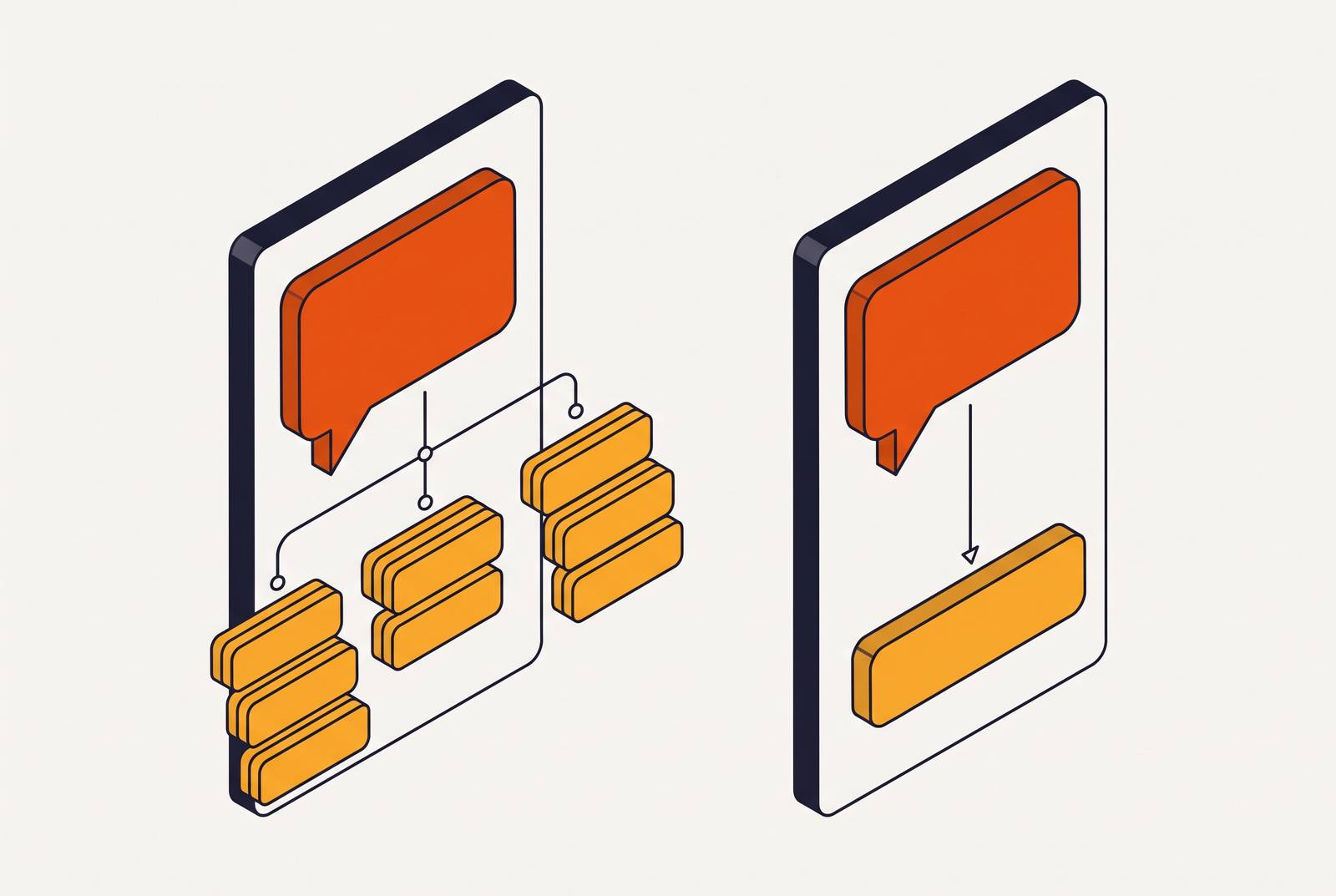
This LinkedIn Conversation Ads vs Message Ads comparison comes down to one rule. Choose by the offer and audience. Both formats reach the same inbox, but only one lets prospects choose a path. Adside can simplify the work of building and managing either format, but it cannot replace that basic decision.
What LinkedIn Conversation Ads and Message Ads actually are and how they share the same delivery layer
Message Ads, formerly Sponsored InMail, deliver a single message with one CTA button and one destination. The format includes a real LinkedIn profile as sender, a subject line, and a message body. Both text fields have character limits. The button leads to a landing page or Lead Gen Form, so the experience follows a straight line from message to action.
Conversation Ads launched in March 2020 as an extension of Message Ads. They use the same sponsored inbox delivery layer and targeting infrastructure, with delivery when recipients are active on LinkedIn. The fork comes after the opening message, where recipients choose among buttons that trigger pre-written follow-ups. A flow can contain up to 5 CTA buttons per message and up to 50 total buttons, with a default “Not Interested” button in every intro. The format supports five campaign objectives, namely Brand Awareness, Website Visits, Engagement, Lead Generation, and Website Conversions.
The 45-day frequency cap and the EU restriction — two constraints that shape every campaign decision before creative even begins
The commonly cited 45-day cap allows a member to receive one Message Ad or Conversation Ad from all advertisers combined during that period. But sources give different windows, with some citing a longer one for Conversation Ads and others a shorter one shared by both formats. The precise interval should not be treated as settled, but the shared constraint should, with planning built around a conservative window.
The undisclosed share of a target audience blocked by other advertisers’ sends on LinkedIn makes reach hard to predict, especially for small, valuable audiences such as C-suite members or people in specific industries. A campaign may have enough profiles that meet its targeting rules on paper but far fewer inboxes it can reach. The planning response is to build an audience larger than the desired send volume, launch during lower advertiser activity, and coordinate sends across internal teams.
Geography can rule out both formats before that planning begins. LinkedIn withdrew EU member targeting for sponsored messaging from December 2021 for new campaigns and January 10, 2022 for existing campaigns. A European Court of Justice ruling made native inbox advertising subject to the rules for direct marketing consent under the ePrivacy Directive. EU and EEA audiences are unavailable, while the UK remains targetable, so a primarily European ideal customer profile points instead toward feed formats such as Sponsored Content and Document Ads.
How the branching structure of Conversation Ads changes what a recipient does — and what that costs
A Message Ad asks the recipient to make one decision about one offer. The person either clicks or does not. A Conversation Ad instead lets prospects route themselves by intent, role, or buying stage. An opening might offer a demo, a case study, or pricing information, with each choice leading to a tailored follow-up and a matching destination.
That choice creates a qualification signal before anyone fills in a form. Across recipients, one Conversation Ad can support a Lead Gen Form fill, a website visit, or another step in the scripted exchange. The advertiser learns which path appealed to the prospect rather than only whether the opening offer earned a click.
Both formats use cost-per-send pricing, so the advertiser pays when the intro message lands in an inbox. Message Ads have a lower cost-per-send range that depends on how senior the audience is, while Conversation Ads have a higher range for senior roles. The available figures do not establish numerical price bands, so a precise budget comparison would overstate the evidence. Building the flow adds work because each branch that leads to an action needs its own follow-up and destination.
Conversation Ads also carry more specifications to manage. The ad name has an internal-only character cap, the subject line has its own limit, and intro and follow-up messages each have a generous character allowance. The optional banner image is sized for desktop only. Those requirements sit on top of the button limits, making a complete flow a larger build than a subject line, body, and single CTA.
What the performance data actually shows — and where the "Conversation Ads win" consensus breaks down
Conversation Ads post roughly 4–10% CTR, while Message Ads post a materially lower rate. That gap does not settle the format choice, because a branch click and a completed lead are different outcomes. Sponsored messaging CTR also uses sends as its denominator. So a direct comparison of those figures with feed-ad CTRs can give the wrong impression of how well each performs.
Ads in the inbox can have open rates of 40–60%, above typical email open rates, but the controlled comparison shows that a richer format can fall short of a simpler one. Message Ads have higher open rates than Conversation Ads. Their simpler format and lower perceived commitment may reduce friction at the opening stage. But Conversation Ads have higher form completion rates, which fits with prospects making their intent clear before they reach the final CTA.
A study compares results within the same account to help judge cost per lead. Its controlled comparison gives no statistical support to the claim that Conversation Ads always do better. Message Ads can deliver meaningfully lower CPL for straightforward content offers, while demo-request comparisons show a large gap with wide variance. The confidence interval spans zero, so neither format wins consistently when the variables at the account level are kept the same.
For either format, retargeted audiences have higher lead rates, higher open rates, and lower CPL than cold audiences. Choose based on whether the offer needs qualification. A higher click rate is not a reason to insert extra decisions between a ready prospect and a clear offer.
Which format fits which funnel stage and offer type
Message Ads fit a single, clear, time-sensitive offer. Webinar registrations, event invitations, content downloads, and promotional announcements do not necessarily need a branching exchange. For these offers, one CTA keeps the route short, especially when the audience already has enough context to act. Message Ads with Lead Gen Forms are a strong fit for event and webinar invitations, where speed and simplicity matter.
The same logic supports Message Ads for top-of-funnel awareness when a single asset or registration is the desired outcome. That does not make them a recommendation for cold prospecting. Funnel stage and audience warmth are separate variables, and an early-stage prospect can already know the brand. Lower cost per send and lighter setup also make Message Ads the more practical choice when time or budget governs the campaign.
Conversation Ads fit mid-to-bottom-funnel work where the next step depends on who the recipient is or what they need. In account-based marketing, an economic buyer, technical evaluator, and end user can take different paths from the same opening. Strong use cases include target-account demo booking, post-event trade show follow-up, content routing, competitive displacement, and customer expansion into adjacent products. People who have visited the website or engaged with content know enough to choose among those paths.
Neither format is recommended for cold top-of-funnel outreach. People expect ads in their inbox to be relevant to them, and cost-per-send pricing can be hard to justify when they have no prior context. Cold messaging also has a high risk that people will opt out. Branching cannot manufacture familiarity, so a more elaborate flow is not a cure for an unprepared audience.
How to design a Conversation Ad flow that actually branches toward conversion
A Conversation Ad with one path is functionally a Message Ad. The useful architecture is two to four intent-qualified branches, each ending at an action suited to the prospect’s buying stage. The opening is the first design decision, and it should provide ungated value before asking for anything. A relevant question or insight gives the recipient a reason to continue without making the exchange feel like a cold demo request.
The first branch then separates prospects by intent, role, or use case. Intent choices might distinguish active evaluation from research without a timeline or simple curiosity. Prospects with high intent move toward a demo, those with mid-level intent toward content, and those with low intent toward a subscription or newsletter.
The second branch matches content to that choice. An active evaluator might see options to book a demo, see pricing, or review case studies, while a researcher might receive a buyer’s guide or newsletter option. The final decision is action capture, where each terminal branch needs a specific destination. Demo paths should land on a calendar booking page rather than a generic request form, content paths on the actual asset rather than the homepage, and newsletter signups on a single-field form.
LinkedIn requires a specific sender for Conversation Ads, either an individual profile or a company page, and sender credibility and seniority are variables to test. Most opens happen on mobile, so test branching CTAs there before desktop to catch truncation. Dynamic macros can supply first name, company, job title, and industry, while “Not Interested” lets recipients delete or archive the message and gives LinkedIn a signal to reduce campaign exposure.
Where AI-assisted campaign management changes the effort equation for both formats
The operational burden of Conversation Ads comes from coordinating several connected tasks. Flow design, branch scripting, sender coordination, mobile testing, and branch-level monitoring all take time. AI agents with campaign context can compress that work, although capabilities differ across platforms. LinkedIn campaign creation can move from tens of minutes of Campaign Manager navigation to under a minute of natural-language instruction, but faster creation does not remove the need to review the result.
Adside streamlines the choice between a one-shot send and a branching flow by automating decision-tree logic and variant testing in a unified interface. A team can use that unified approach, work manually in Campaign Manager, or assemble separate research tools, analytics dashboards, creative suites, and bulk-import apps. The latter approaches leave more coordination to the team, while a unified workspace reduces those handoffs.
The qualification signal becomes more useful when it can be read against actual conversion performance. With LinkedIn inbox ads and cross-channel performance data brought together in Adside, branch choices can sit beside web behavior and ad spend. Connected AI agents can create a feedback loop by tracking open rate, branch click distribution, and CTA conversion rate to find paths that need to be updated.
Human approval remains part of that loop. AI can propose variants and branch structures from performance signals, while a person reviews and approves them before launch. This makes automation a way to reduce production effort without surrendering the campaign’s logic. It changes the setup calculation for Conversation Ads, but not the need for a suitable offer and audience.
A side-by-side reference for making the final format decision
Start with geography, then audience warmth. If the ideal customer profile is mainly in the EU/EEA, both inbox formats are ruled out and feed-based options are the next choice. A cold audience is a poor fit for either, regardless of location. After those checks, the choice depends on whether the offer needs one clear action or several paths based on who prospects are and what they need.
For Message Ads, the reference is one CTA, a linear flow, lighter setup, and the lower cost-per-send range. They work well for warm audiences who are being sent one asset, announcement, or event invitation. For Conversation Ads, the reference is multiple CTA choices, scripted branches, greater setup effort, and a higher cost-per-send range for senior roles. They work well for warm audiences who need a path based on their role or whose intent needs to be clear before a demo, content offer, or sales action.
Read the metrics in that context. Message Ads lead on opens in controlled comparisons, while Conversation Ads lead on CTR and form completion, without a statistically supported universal CPL advantage. Both remain subject to sponsored messaging’s shared frequency constraint, so timing and audience-pool planning apply whichever format wins the brief. Where full flow design and mobile testing are not feasible, the simpler format has a practical advantage.
Adside is an option for planning, building, monitoring, and optimizing both formats without stitching together a separate stack. That can make a qualified branching campaign easier to run, but it is equally useful when the right answer is one message and one button. Choose the shortest path that gives the prospect the right next step.